Franklin County property value update timeline (2026)
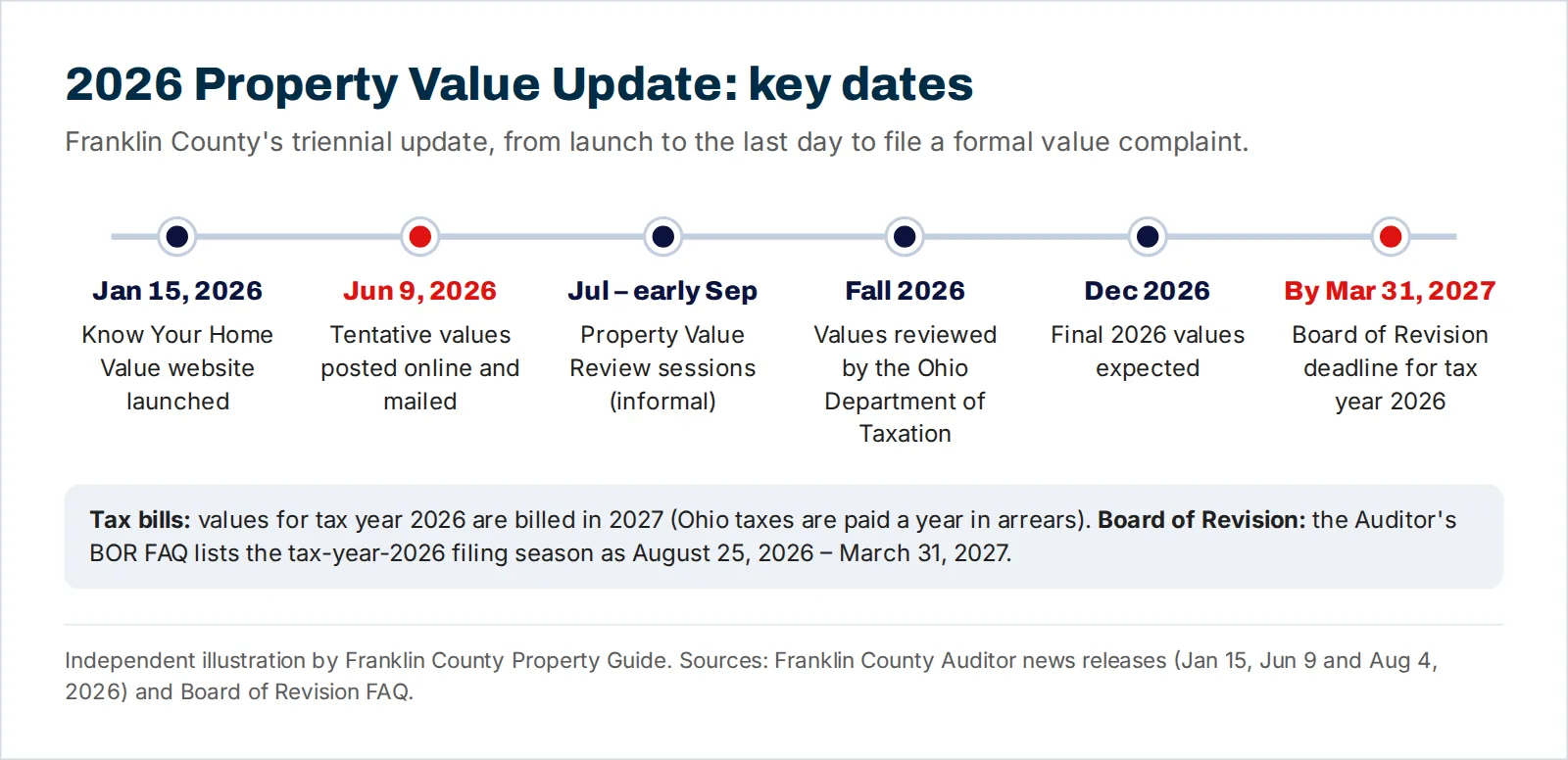
| Date | Milestone | Status |
|---|---|---|
| January 15, 2026 | Auditor launches the Know Your Home Value website with the timeline, a printable guide and FAQs | Done |
| June 9, 2026 | Tentative 2026 values posted online (and mailed in June) | Done |
| July – early September 2026 | Informal Property Value Review sessions, virtual or in person | Ended |
| After reviews | Values submitted to the Ohio Department of Taxation for review | In progress |
| December 2026 | Final values expected | Upcoming |
| Through March 31, 2027 | Board of Revision complaints for tax year 2026 | Filing season open (see note) |
| 2027 | Tax bills reflecting the new values (tax year 2026 is billed in 2027) | Upcoming |
Review sessions: the Auditor’s August 4, 2026 release said sessions were available through September 5; WOSU (August 7, 2026) reported virtual meetings available until September 4. Either way, they have ended.
BOR filing window: the Auditor’s Board of Revision FAQ lists the tax year 2026 filing season as August 25, 2026 – March 31, 2027, while its Tax Reduction Programs page describes the window as “mid-November through March 31 every year.” The FAQ is the more specific, year-dated source. Both agree on the March 31, 2027 deadline, which is what matters most.
What the 2026 update is (and isn’t)
Ohio law requires county auditors to update property values every three years so they reflect the current market. Franklin County does a full reappraisal every six years and an update in between. 2023 was the full reappraisal; 2026 is the update.
What it is
A data review of arm’s-length sales prices from 2023, 2024 and 2025, used to set a new value for every parcel in the county, more than 440,000 in all.
What it isn’t
A full reappraisal. Unlike 2023, the 2026 update doesn’t include a complete exterior inspection of each parcel. That’s why checking your record’s building details matters: the update relies on the data already on file.
You’ll often hear it called the Franklin County 2026 reappraisal, but officially it’s an update, the lighter review that falls between full reappraisals. Franklin County tentative values were released June 9, 2026, and final values are due in December 2026.
How much values changed in 2026
The Auditor released preliminary countywide figures with the tentative values on June 9, 2026:
- ~10%average residential increase
- ~4%average commercial increase
- ~13%average industrial increase
- 5–15%typical residential range by school district
Auditor Michael Stinziano described the 2026 changes as more stable than 2023, when the full reappraisal raised median residential values by 41%: “Property values are increasing at a more stable rate, but we know any change in value can raise questions.”
Axios Columbus reported on May 20, 2026, before tentative values were released, that the average residential increase would be 9%, with Bexley highest at 14% and Hamilton, Gahanna-Jefferson and Groveport-Madison lowest at 7%. The Auditor’s June 9 release, which is newer and official, reported approximately 10% on average and a typical range of 5% to 15% by school district. Use the Know Your Home Value site for the official average in your school district.
How to look up your tentative 2026 value
- Open Know Your Home Value. The Auditor’s 2026 site is at audr-kyhv.franklincountyohio.gov (also linked as auditor.franklincountyohio.gov/KYHV).
- Find your property. Look up your parcel to see its tentative 2026 value next to the current value.
- Compare with your school district’s average. The site lists average preliminary value changes by school district and neighborhood delineation maps.
- Estimate the tax effect. The site includes a property tax estimator. Our estimator guide explains what it can and can’t tell you.
- Check your building details in the regular property search, since the update relied on the data on file.
The review sessions are over. What can you do now?
If you missed the summer Property Value Reviews, you still have options.
| Situation | What to do | When |
|---|---|---|
| Your record has a factual error (square footage, baths, condition) | Contact appraisal staff at 614-525-4663 or [email protected] with documentation | Any time |
| You think the value is too high | File a Board of Revision complaint (DTE 1) with evidence | By March 31, 2027 |
| You’re not sure yet | Wait for final values in December, then decide | December 2026 – March 2027 |
| Your building was damaged | Ask about a damaged property value reduction (DTE 26) | Promptly after the damage |
Final values can differ from tentative values after the reviews and state review, so it’s reasonable to wait for December before filing, as long as you don’t miss March 31.
What the update means for your 2027 tax bill
New values apply to tax year 2026, which is billed and paid in 2027. Several things interact:
- Reduction factors. Most voted levies can’t collect more because values rose, so their effective rates fall. The Auditor has stressed that a change in value does not mean an equal percentage change in taxes.
- Your value vs. your district. If your increase is below your school district’s average, your share of the levies may shrink; above average, it may grow.
- Inside millage now capped. Under House Bill 335, in reappraisal and update years, county budget commissions must limit revenue growth from unvoted inside millage to inflation (the GDP deflator over the preceding three years). 2026 is the first update year under this rule.
- Bigger owner occupancy credit. Under House Bill 186, the owner occupancy credit rises to 5.70% for tax year 2026, while the 10% nonbusiness credit on residential property drops to 7.5%. For an owner-occupied home the combined credit rises from 12.5% to 13.2%; for a rental it falls from 10% to 7.5%. See the owner occupancy credit guide.
- New levies. Levies approved by voters, including at the November 3, 2026 election, can add to bills.
Our property tax guide walks through the full calculation.
Four scenarios: what your 2026 value change means
A. Your increase is below your district’s average
If your school district averaged, say, a 10% increase and yours rose 5%, your share of the district’s voted levies may shrink, because reduction factors are based on the district-wide change. Your bill could stay flat or even fall, before new levies and credit changes.
B. Your increase is well above average
Check the record first. A much larger increase than your neighbors can point to a data change, such as an addition picked up from a permit, or an error. If the record is right and the value still looks high against sales, gather comparable sales.
C. You bought recently for less
If you bought in an arm’s-length sale near January 1, 2026 for clearly less than the tentative value, your closing statement and purchase contract are strong evidence for a Board of Revision complaint.
D. Your home needs major repairs
Because the 2026 update didn’t include a full exterior inspection, condition problems may not be reflected. Photos and contractor estimates are the evidence to gather.
These scenarios explain direction, not dollar amounts; your actual tax also depends on levies and credits. The estimator guide shows how to run the numbers.
Informal review vs. formal Board of Revision complaint
| Informal Property Value Review | Board of Revision complaint | |
|---|---|---|
| When | During update and reappraisal years, before values are final (July–early September 2026) | After values are set, by March 31 of the following year |
| With whom | Auditor’s appraisal staff | The Board of Revision (Treasurer, Auditor and a County Commissioner, or their representatives) |
| Format | About 20-minute virtual or in-person session, or documents only | Written complaint (DTE 1), then mediation or a hearing |
| Best for | Correcting facts and raising concerns early | Disputing market value with evidence |
| Appeal rights | Not a formal decision | Decisions can be appealed within 30 days |
| 2026 status | Closed | Open through March 31, 2027 |
Checklist before final values arrive in December
- Save your tentative value from Know Your Home Value, so you can compare it with the final value.
- Review your record for errors in size, rooms, basement, garage and condition, and report them now.
- Collect comparable sales from 2023–2025, with an emphasis on those close to January 1, 2026.
- Gather documents: purchase paperwork if you bought recently, any appraisal, photos and repair estimates.
- Make sure your credits are in place. Apply for the owner occupancy credit and, if eligible, Homestead by December 31, 2026. See the tax relief guide.
- Put March 31, 2027 on your calendar as the last day to file a complaint.
How the state review works now
After the local review period, the Auditor submits values to the Ohio Department of Taxation, which checks them for uniformity before they become final. House Bill 124, effective March 2026, changed that review: the Department must use the sample of property sales provided by the county auditor, all open-market, arm’s-length transactions from the previous three years, rather than its own sample. The bill also sped up review deadlines and opened routes to appeal state review decisions to the Board of Tax Appeals and the Ohio Supreme Court.
What to watch for in December
- Final values: compare with your tentative value. A change can reflect review corrections or state adjustments.
- New rates: tax rates for tax year 2026 reach the Auditor in mid-December, including new reduction factors that respond to the value changes.
- Credit deadlines: Homestead and owner occupancy applications for tax year 2026 are due December 31.
- Your decision: with final values and new rates in hand, decide whether a Board of Revision complaint is worth filing before March 31, 2027.
Preparing to challenge your 2026 value
Whether you use an informal review or a formal Board of Revision complaint, evidence decides the outcome. Useful documentation includes:
- Comparable sales of similar homes nearby from 2023–2025, the period the update relied on;
- a professional appraisal by a certified Ohio appraiser (the BOR asks for the full report);
- your own purchase documents if you bought recently: closing statement, purchase contract and deed;
- photos of condition problems;
- repair estimates or records for major defects;
- corrections to wrong characteristics on your record.
The Board of Revision guide walks through filing, hearings, mediation and appeals.
What the 2026 update means for landlords, businesses and renters
Landlords
Rental homes are valued like other residential property, but for tax year 2026 their nonbusiness credit drops from 10% to 7.5% under House Bill 186, and it phases out by 2029. A higher value plus a smaller credit can mean a larger increase than an owner-occupant sees.
Commercial and industrial owners
Preliminary averages were about +4% for commercial and +13% for industrial property. Class II reduction factors will reflect those changes. Entity owners considering a Board of Revision complaint should talk to an attorney.
Renters
Renters don’t receive tax bills, but landlords’ costs can affect rents. Auditor Michael Stinziano warned before House Bill 186 was signed that removing the credit on rentals could hurt renters if costs are passed along.
2026 compared with the 2023 reappraisal
| 2023 reappraisal | 2026 update | |
|---|---|---|
| Type | Full reappraisal | Triennial update |
| Method | Included an exterior inspection of each parcel | Data review of 2023–2025 arm’s-length sales |
| Residential change | Median +41% | Average about +10% (preliminary) |
| Commercial/industrial change | Median +16% | About +4% commercial, +13% industrial (preliminary) |
| State law context | Before the 2025 reforms | First update under HB 335’s inside millage cap and HB 186’s new credits |
2026 update terms
| Term | Meaning |
|---|---|
| Triennial update | The value update at the midpoint of the six-year reappraisal cycle |
| Tentative value | The proposed new value released in June, before state review |
| Final value | The value after reviews and state approval, expected in December 2026 |
| Property Value Review | The informal summer review session with appraisal staff |
| Neighborhood delineation | How the county groups similar areas for valuation, shown on maps on the Know Your Home Value site |
| Arm’s-length sale | A sale between unrelated, willing parties, used to set values |
| Board of Revision | The board that hears formal value complaints; see the BOR guide |
If you bought your home during 2026
Values for tax year 2026 are set as of January 1, 2026. If you bought after that date:
- the 2026 value applies to your home even though you didn’t own it on January 1;
- your purchase price can still be useful evidence if the sale was arm’s-length and close in time to January 1; ask about it before filing a Board of Revision complaint;
- credits that depend on owning and living in the home on January 1, such as the owner occupancy credit and the Homestead Exemption, start with tax year 2027 for you.
If your change differs from your school district’s average
Averages hide a lot of variation. A result well above the average isn’t automatically wrong, and one below it isn’t automatically right. Work through it:
- Check the record’s facts first; data errors are the most common cause of outliers.
- Look at your neighborhood, not just the district. The Know Your Home Value site’s neighborhood delineation maps show how the county grouped areas.
- Compare with sales of truly similar homes near January 1, 2026.
- Decide whether to file with the Board of Revision by March 31, 2027.
Your next steps, by date
| By | Do this |
|---|---|
| Now | Save your tentative value; review your record; report errors |
| December 2026 | Compare your final value with the tentative value |
| December 31, 2026 | File for the owner occupancy credit and Homestead if eligible |
| January–March 2027 | Gather evidence and decide on a complaint |
| March 31, 2027 | Last day to file with the Board of Revision for tax year 2026 |
| 2027 | Check your first tax bills using the new values; see the tax bill guide |
Why Ohio updates values every three years
Property taxes are divided among owners based on value. If values went stale, owners in fast-rising neighborhoods would pay less than their share and owners in slower areas more. Regular updates keep the split fair. The Ohio Department of Taxation reviews each county’s values for uniformity, and since House Bill 124 took effect in March 2026, it must use the county auditor’s own sample of arm’s-length sales from the prior three years in that review.
For the appraisal method itself, see how Franklin County property values are set.
The 2026 update at a glance
- 440,000+parcels revalued
- ~10%average preliminary residential increase
- Dec 2026final values expected
- Mar 31, 2027Board of Revision deadline
What if my value went down, or barely changed?
A value that falls or stays flat while your school district averages a larger increase usually means your share of voted levies goes down. But your tax can still rise if new levies pass, if a credit changes, or if a special assessment is added. As Auditor Michael Stinziano put it to WOSU: “Your value can go up, taxes down. Your value could go down, your taxes up.” The relationship depends on your whole district, not your parcel alone.
2026 value update: frequently asked questions
When will final 2026 property values be released in Franklin County?
The Auditor expects final values in December 2026, after the Ohio Department of Taxation reviews them.
How much did Franklin County property values go up in 2026?
Preliminary figures released June 9, 2026 showed average increases of about 10% for residential, 4% for commercial and 13% for industrial property, with residential averages generally between 5% and 15% by school district.
Where can I see my tentative 2026 property value?
On the Auditor’s Know Your Home Value website at audr-kyhv.franklincountyohio.gov, which also shows averages by school district and includes a tax estimator.
Can I still request a Property Value Review?
The 2026 review sessions ended in early September. You can still report factual errors to the Auditor’s appraisal staff at any time, and file a formal Board of Revision complaint through March 31, 2027.
When will the new values affect my property taxes?
The 2026 values apply to tax year 2026, which is billed and paid in 2027.
How do I appeal my 2026 Franklin County property value?
File a complaint with the Franklin County Board of Revision on form DTE 1, with evidence such as comparable sales or an appraisal, by March 31, 2027.
Does a 10% value increase mean a 10% tax increase?
No. Ohio reduction factors lower effective rates on most voted levies when values rise, and 2025 legislation caps growth on inside millage. Your tax change depends on your value change compared with your district and on any new levies.
Why didn’t anyone inspect my house for the 2026 update?
The 2026 triennial update is a data review of 2023–2025 sales, not a full reappraisal. The last full reappraisal, in 2023, included an exterior inspection of each parcel.
Will my final 2026 value be the same as my tentative value?
Not necessarily. Informal reviews and the state’s review can change values before they’re final in December. Compare the two when final values are released.
Related guides
Sources
Facts on this page were checked against these official sources on September 26, 2026:
- Franklin County Auditor – Auditor's Office launches website for 2026 Property Value Update (January 15, 2026)
- Franklin County Auditor – Tentative property values now available online (June 9, 2026)
- Franklin County Auditor – Property Value Review sessions now underway (August 4, 2026)
- Franklin County Auditor – Appraisal (2026 triennial update method)
- Franklin County Auditor – Board of Revision and BOR FAQ
- Franklin County Auditor – Tax Reduction Programs (BOR filing window description)
- WOSU Public Media – Property owners can ask for reviews on tentative values (August 7, 2026)
- Axios Columbus – Franklin County home values are rising again (May 20, 2026)
- Ohio Legislative Service Commission – H.B. 186 final analysis
- Vorys – Ohio's new property tax legislation (HB 335 inside millage limits)
Last updated September 26, 2026. Found an error? Report it here — see our editorial policy for how we check facts.