Franklin County Board of Revision
If you think your property’s value is off, the Board of Revision is Ohio’s formal process for challenging it. It’s specifically about valuation — not about your tax rate, a specific levy, or a billing error, which are different problems handled differently. This page explains what the Board is, when it’s the right tool, what filing actually involves, and what happens after you do.
What Is the Franklin County Board of Revision?
The Board of Revision is a three-member body — by Ohio law, made up of the county Auditor, the county Treasurer, and the president of the Board of County Commissioners (or their designated representatives) — that hears formal complaints from property owners who believe their property’s appraised value is incorrect. It has the authority to review evidence and adjust a property’s value if the evidence supports it, but it doesn’t set tax rates or approve levies — those are separate, largely voter-driven processes.
In practice, most people encounter the Board of Revision after receiving a valuation notice that doesn’t match their expectations, or after comparing their assessed value to recent sales of similar homes nearby.
When Should You Consider a Property Value Appeal?
A few common situations lead property owners to look into filing:
- A recent arm’s-length sale of the property itself came in noticeably below the appraised value
- Comparable homes nearby have sold for meaningfully less than what the county’s valuation implies
- The record contains a factual error about the property — incorrect square footage, a feature that doesn’t exist, or damage that hasn’t been reflected
- A significant change to the property (like storm damage) that hasn’t been accounted for in the current value
It’s worth being clear about one distinction: “I think my property is worth less” is a valuation question that the Board of Revision addresses. “I disagree with my tax bill” might actually be about a levy, a rate, or a missing exemption — none of which a valuation complaint fixes on its own. If it’s the bill itself that seems wrong rather than the underlying value, Franklin County property taxes is the better starting point.
What Property Value Can Be Challenged?
A Board of Revision complaint specifically targets appraised value — the Auditor’s estimate of a property’s market worth — since that figure is what everything else (assessed value, taxable value, and ultimately the tax calculation) flows from. Successfully lowering appraised value through the Board reduces assessed and taxable value accordingly. For a fuller breakdown of how these different value concepts relate, see Franklin County property values.
Who Can File a Board of Revision Complaint?
Property owners are the most common filers, but Ohio law allows other parties an interest in the valuation — including, in some circumstances, taxing authorities like school districts — to file or respond to complaints as well. That means a complaint you file isn’t necessarily uncontested; larger valuation changes in particular can draw a response from an interested taxing authority. Exact filing eligibility and representation rules can have nuances depending on your situation (co-ownership, trusts, recently transferred property), so if yours isn’t a straightforward single-owner case, it’s worth confirming your specific standing to file with the Auditor’s Office before you do.
How to File a Franklin County Board of Revision Complaint
- Identify the property and pull its current valuation information.
- Decide specifically why you believe the value should be reviewed — a low sale price, comparable sales, a factual error, or documented damage.
- Gather supporting evidence for that specific reason.
- Obtain the current DTE Form 1 (“Complaint Against the Valuation of Real Property”) from the Auditor’s Office.
- Complete the form with the required property and valuation information.
- Submit it through whatever method the Auditor’s Office currently accepts — historically this has included mail and in-person filing, alongside online options where available.
- Keep confirmation of your submission.
- Watch for scheduling notice and prepare your evidence for a hearing.
- Review the Board’s written decision once issued.
Franklin County has also offered a mediation option for property owners who’d rather try to resolve a disagreement without a formal hearing — worth asking about if a full hearing feels like overkill for your situation.
Board of Revision Filing Deadlines
This is the part most worth getting exactly right, and it’s a little more specific than “January through March” — which is the simplified version you’ll see on a lot of secondhand sites.
Franklin County property tax is billed a year in arrears: the taxes billed in a given calendar year correspond to the prior year’s tax valuation. Following that logic, the Auditor’s Office has described its Board of Revision complaint season for a given tax year as opening in late October of that tax year and closing March 31 of the following calendar year — for example, a tax-year-2025 complaint season running from roughly October 30, 2025 through March 31, 2026.
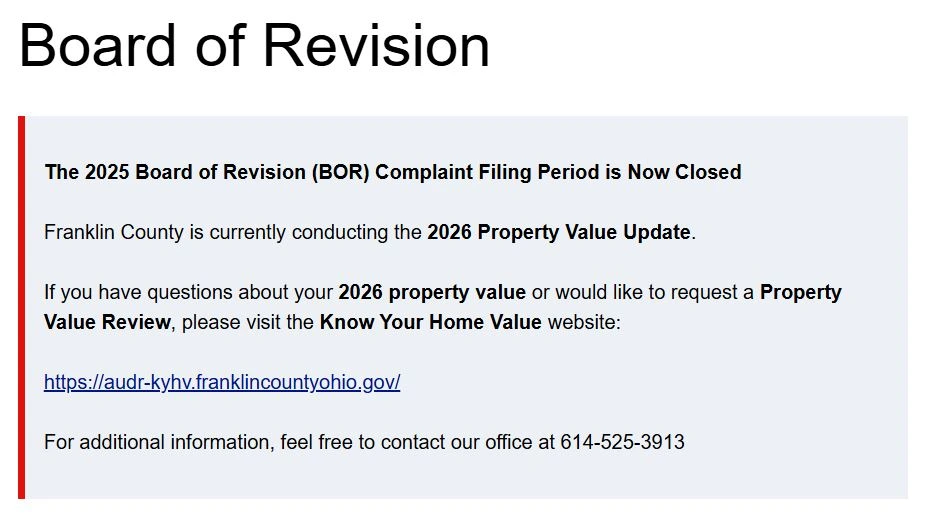
As of this writing, the most recent standard filing season has already closed, and the county is in the middle of its 2026 property value update, with an informal Property Value Review Session process available directly through the Auditor’s Office for property owners who want to raise a concern before the next formal Board of Revision season opens. Given how specific and consequential this date is, confirm the exact current filing window directly with the Auditor’s Office before you plan around it — don’t rely on this page, or any other secondhand source, for the literal date you file by.
What Evidence Can Support a Property Value Appeal?
Evidence that tends to carry weight includes:
- A recent, arm’s-length sale of the property itself
- An independent professional appraisal
- Comparable sales of similar nearby properties
- Photographs documenting condition or damage
- Documentation of a factual error in the property’s recorded characteristics
None of this guarantees a particular outcome — the Board weighs whatever evidence is presented against the current valuation, and what counts as sufficiently persuasive can depend on the specifics of your case.
How to Research Your Property Before Filing
Before you file anything, it helps to build your case methodically:
- Search for the property to pull its current record.
- Review its recorded characteristics for accuracy.
- Review its valuation and value history.
- Check its fuller property record for sales and transfer history.
- Research recent comparable sales nearby.
- Line up your evidence against the specific basis for your complaint.
What Happens After You File?
In general terms, filing starts a process that includes the county reviewing and acknowledging your complaint, scheduling a hearing, giving you notice of that hearing date, and eventually issuing a written decision. Exact timing and procedural steps can vary by case load and year, so treat this as the general shape of the process rather than a fixed timeline — the Auditor’s Office can confirm current processing times.
What Happens at a Board of Revision Hearing?
A hearing is generally a relatively brief, focused session where you present your evidence and explain why you believe the value should change. Expect to answer questions from Board members about your evidence. Being organized — a clear, evidence-first presentation rather than a general complaint about taxes — tends to serve property owners well. This isn’t legal advice, and there’s no guaranteed outcome; the Board weighs the specific evidence presented against the current value.
Possible Board of Revision Outcomes
Broadly, a complaint can result in the value staying the same, being adjusted (which can mean lowered, though in principle also raised if the evidence points that direction), or the complaint being denied outright. Which outcome applies depends entirely on the evidence presented and the Board’s determination — no source can predict a specific result in advance.
What If You Disagree With the Decision?
Ohio law generally provides further review options beyond the Board of Revision, such as an appeal to the Ohio Board of Tax Appeals or a county court. These further-appeal windows tend to be short and start running from the date of the Board’s decision notice — if you’re considering this route, treat the deadline as urgent and confirm the exact current window immediately with the Auditor’s Office or a qualified professional rather than assuming you have ample time.
Board of Revision vs. Property Tax Questions
The Board of Revision is about disputing a property’s underlying value. Franklin County property taxes covers the broader system — how rates, levies, and exemptions combine with that value to produce your actual bill. If your concern is about a rate, a levy, or a bill that doesn’t reflect a credit you expect, that page — not a valuation complaint — is the right starting point.
Board of Revision vs. Property Value Information
Franklin County property values explains how valuation works in general — what appraised, assessed, and taxable value mean and how they’re determined. This page picks up from there: what to do once you’ve concluded your specific value looks wrong.
Frequently Asked Questions
What is the Franklin County Board of Revision?
A three-member body — the county Auditor, Treasurer, and Commission President — that hears formal complaints from property owners who believe their property’s appraised value is incorrect.
How do I appeal my property value in Franklin County?
File a Complaint Against the Valuation of Real Property (DTE Form 1) with the Auditor’s Office during the current filing season, supported by evidence like a recent sale, an appraisal, or comparable sales.
How do I file a Board of Revision complaint?
Obtain and complete DTE Form 1, gather supporting evidence for your specific basis of complaint, and submit it through the Auditor’s Office’s currently accepted filing method.
When is the Board of Revision filing deadline?
Franklin County’s complaint season for a given tax year has generally run from late October of that year through March 31 of the following year, but confirm the exact current dates directly with the Auditor’s Office before relying on them.
What evidence do I need for a property value appeal?
Recent arm’s-length sale data, an independent appraisal, comparable sales, photographs, or documentation of a factual error in the property’s record all commonly support a complaint.
Can I challenge my home’s assessed value?
You challenge the underlying appraised value; since assessed and taxable value are calculated from it, a successful complaint adjusts those figures accordingly.
What happens after I file a complaint?
Generally, the county reviews and acknowledges the filing, schedules a hearing, and eventually issues a written decision — exact timing varies.
What happens at a Board of Revision hearing?
You present your evidence and reasoning to the Board and answer their questions. It’s typically a fairly brief, focused proceeding rather than a lengthy trial-style hearing.
Can a Board of Revision change my property value?
Yes — the Board can adjust a value up or down, or leave it unchanged, based on the evidence presented, or deny the complaint outright.
What if I disagree with the Board’s decision?
Ohio law generally allows further appeal, such as to the Ohio Board of Tax Appeals or a county court, within a limited window after the decision — confirm the current deadline immediately if you’re considering this.
Is a property value appeal the same as disputing my property tax bill?
No. A value appeal challenges the underlying appraised value; a billing dispute is usually about rates, levies, or a missing credit, which is a different process.
Where can I verify current Board of Revision requirements?
Through the Franklin County Auditor’s official Board of Revision page, linked below.
Review Your Property Information
Franklin County Property Guide explains how the Board of Revision process generally works, but it doesn’t accept complaints, schedule hearings, or decide valuations.
Review your property information → — a useful first step before deciding whether a complaint makes sense.
For the official Board of Revision page, current filing status, and forms, visit auditor.franklincountyohio.gov/Real-Estate/Board-of-Revision