How to read a Franklin County parcel ID
Every piece of land in Franklin County has a permanent parcel number. It’s the one identifier every county office uses: the Auditor for values, the Treasurer for bills, the Board of Revision for complaints and the Recorder’s documents for legal descriptions. On record pages it appears in three parts.
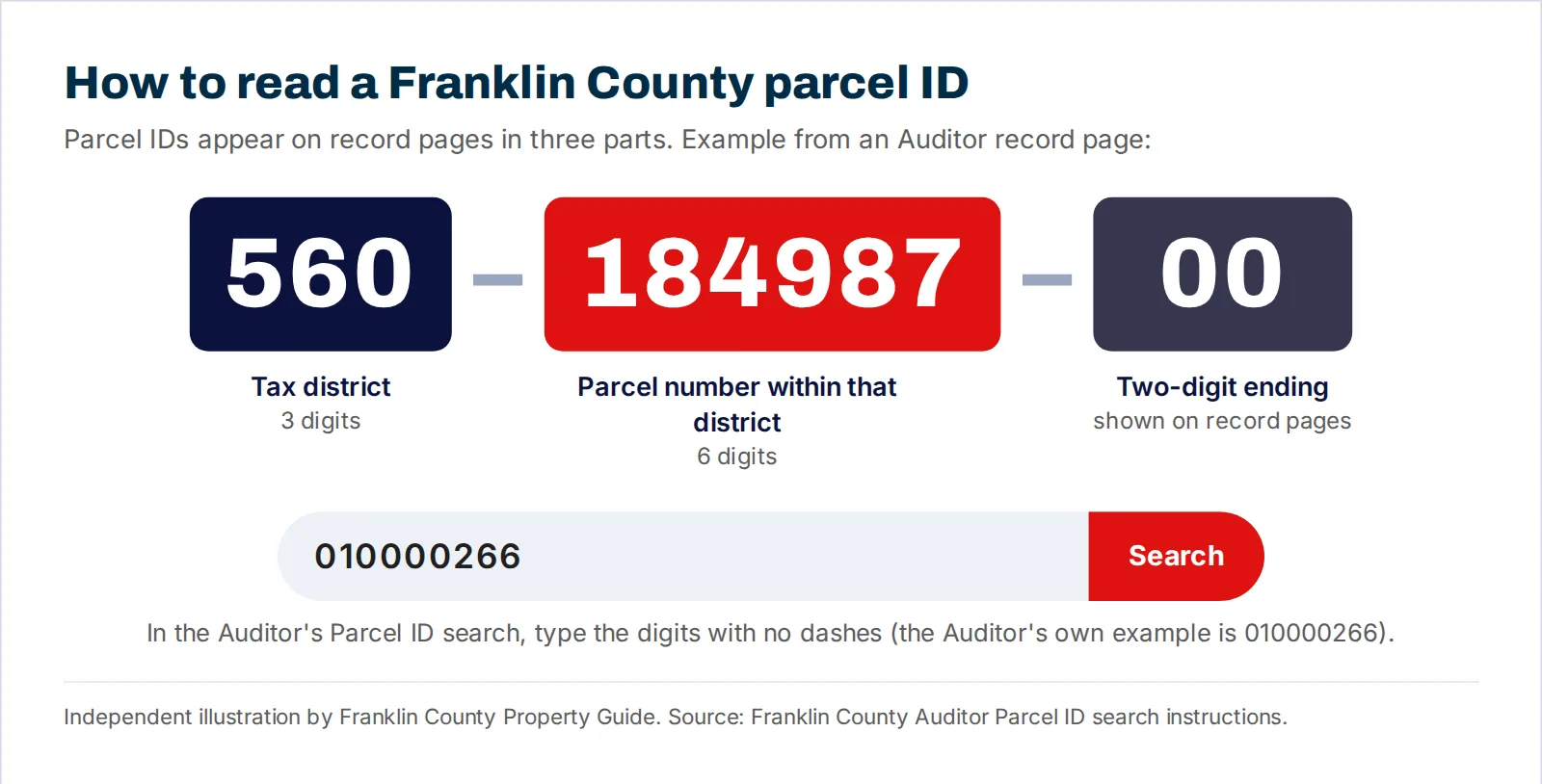
| Part | Example | What it means |
|---|---|---|
| Tax district | 560 | The first three digits identify the taxing district: the combination of city or township, school district and other levies that sets the tax rate. |
| Parcel number | 184987 | Six digits that identify the parcel within that district. |
| Ending | 00 | A two-digit ending shown on record pages. The Auditor’s own search example leaves it off. |
The Auditor’s parcel search help confirms the tax district reading. Its wildcard examples describe 010287* as “all parcels in Tax District 010 beginning with 287.”
Franklin County parcels are numbered in this parcel ID format, so once you can read one number, you can read them all.
Franklin County parcel number lookup: five ways to find yours
1. Address search
Search your address in the Auditor’s property search. The parcel ID is shown at the top of the record.
2. Owner search
Search your name (last name first). Every parcel you own is listed with its number. See the owner search guide.
3. Parcel Viewer map
Zoom to your street and click your lot. The pop-up shows the parcel ID. The GIS guide explains the map tools.
4. Tax bill
Your real estate tax bill identifies the parcel it covers. The Treasurer asks you to write the parcel number on payment checks.
5. Closing and deed paperwork
Conveyance forms, title documents and many deeds list the parcel number along with the legal description.
Once you have the number, every other Franklin County parcel lookup, from the Auditor’s property search to the Treasurer’s tax search, gets faster.
How to search by parcel ID
- Open the Parcel ID search. Go to the official Parcel ID search.
- Type the digits only. The Auditor’s instructions say not to include dashes. Its example is 010000266.
- Be specific. The Auditor advises being as specific as you can. If there’s no exact match, up to 500 results can come back.
- Use wildcards for groups. An asterisk finds a range of parcels: 010287* returns parcels in tax district 010 beginning with 287, and 010*266 returns parcels in district 010 ending with 266.
Typing dashes or spaces, dropping a leading zero (010 is not the same as 10), or using a parcel number from a different county. Delaware, Fairfield and Licking counties use their own numbering, so a Franklin County search won’t find their parcels.
A Franklin County Auditor parcel search by number is the most precise lookup there is, because each parcel ID points to exactly one record.
What the tax district prefix tells you
Two houses across the street from each other can carry different tax district prefixes, and different tax bills, because they sit in different cities, townships or school districts. The prefix is a quick way to see which set of levies applies to a parcel.
- It drives your tax rate. Each district has its own full and effective tax rates. The Auditor publishes rate sheets by year on its Property Tax Rates page. Our tax rates guide explains how to read them.
- It tells you which levies you vote on. School and municipal levies apply by district, which is why the Levy Estimator asks for your parcel.
- It doesn’t always match your mailing city. Many homes with a Columbus mailing address sit in a suburban school district or a township, and the prefix reflects that.
Worked example: from an address to a tax rate
Here’s how the parcel number connects everything the county knows about a property. Follow along with your own address.
- Start with the address. Search it in the property search. The record header shows a parcel ID in the 3-6-2 format, such as 560-184987-00.
- Read the tax district. The first three digits (560 in the example) are the tax district. Every parcel with the same prefix pays the same set of tax rates.
- Look up the district’s rates. Open the Auditor’s rate sheet for the latest tax year and find the district number to see its full and effective rates. See the tax rates guide.
- Check your bill. Search the same parcel in the Treasurer’s tax search. The effective rate on your bill should match your district’s rate for your property class.
- Estimate a levy. Before an election, the Auditor’s Levy Estimator uses your parcel to estimate the cost of proposed levies. See the estimator guide.
The same parcel number is what you’ll write on a tax payment check, enter on a Board of Revision complaint, and use when registering a rental.
Parcel ID search troubleshooting
| Problem | Likely cause | Fix |
|---|---|---|
| No results | Dashes or spaces typed; a missing leading zero; a number from another county | Type digits only, keep leading zeros, confirm the county |
| Hundreds of results | Too few digits entered, so the search is matching broadly | Enter the full number, or use a precise wildcard like 010287* |
| A record for a different property | A digit transposed | Re-check the number against your bill or deed |
| “Inactive” or missing parcel | The parcel was split or combined and retired | Search the Historical Parcel Sheets and the Parcel Archive |
| Tax bill and deed show different numbers | The deed predates a split or combination | Use the current number on the Auditor’s record; call Transfer & Conveyance (614-525-3253) if unsure |
| Several numbers for one building | Condominium units or multiple parcels under one address | Use the Subdivision & Condo search, or check each parcel |
| Search page won’t load | Maintenance (the Auditor warned of outages September 26–27, 2026) | Use the Parcel Viewer map or try later |
Condos, new lots and multi-parcel properties
Condominiums
Each unit typically has its own parcel number, even though units share a street address. When a condo association or lender asks for your parcel number, make sure it’s your unit’s number, not a neighbor’s or the common area’s.
New subdivisions
When land is platted into lots, new parcels are created. Until records catch up, a lot may appear under the original larger parcel. Builders and title companies usually have the new numbers first.
Homes on two parcels
A house and an adjoining side lot, or a home and a detached garage lot, can be separate parcels with separate bills. Combining them uses the Auditor’s Combination Request form.
Parcel numbers in bulk data
For researchers, appraisers and developers, the parcel ID is the key that links the Auditor’s datasets together. It’s the field you’ll use to join map layers to value, sales and tax tables. Official sources include:
- Web Reporter for tabular queries on property data;
- Open Data Portal for GIS datasets and REST services;
- GIS Data Extract for SHP, DXF and FGDB downloads;
- Direct Download (FTP) for bulk current and historical files.
Our GIS and data guide explains each one.
Why official processes use the parcel number, not the address
Addresses change, get re-numbered, or don’t exist at all for vacant land. A parcel number identifies the land itself. That’s why official processes rely on it. For example, the Auditor’s forfeited land sale terms state that sales are based solely on the permanent parcel number, not the street address, and conveyance forms, Board of Revision complaints and Homestead applications all ask for it. When a document lists both, the parcel number is the one to double-check.
Parcel number vs. other property numbers
Property paperwork is full of numbers. Only the parcel ID works in the Auditor’s Parcel ID search. Here is how the others differ.
| Number | Where you’ll see it | What it identifies |
|---|---|---|
| Parcel ID | Auditor record, tax bill, conveyance forms | The land parcel itself, for tax purposes |
| Lot number | Legal description on the deed, subdivision plat | Your lot within a recorded subdivision plat |
| Instrument or document number | Recorder’s records | A specific recorded document, such as a deed or mortgage |
| Conveyance number | Transfers tab on the Auditor’s record | A specific transfer processed by the Auditor |
| Board of Revision case number | BOR letters and case search | A value complaint on the parcel |
“What is my lot number?” Lot numbers explained
Searches like “what is my lot number for my house” usually come from a builder, surveyor, lender or HOA asking for it. A lot number is not the same as a parcel number. It comes from the subdivision plat, the recorded map that divided the land into numbered lots.
- Open your parcel in the Auditor’s property search and find the legal description on the record. In a platted subdivision it usually names the subdivision and your lot number.
- If it isn’t there, check your deed, which quotes the full legal description. Deeds and plats are available through the Recorder’s online search.
- Rural and older parcels described by metes and bounds (distances and bearings) may have no lot number at all.
For boundary questions, see the property lines and plats guide.
When parcel numbers change
Parcel numbers are meant to be permanent, but they change when the land itself changes.
Splits
Splitting a parcel creates new parcels with new numbers. According to the Auditor’s FAQ, the original parcel’s owner still receives the full tax bill until the next tax year, so sort out tax payments at closing.
Combinations
Combining parcels uses the Auditor’s Combination Request form. The combination takes effect immediately, but separate tax bills continue until the next tax year.
Retired parcels
Old numbers don’t disappear from history. The Historical Parcel Sheets tool finds inactive parcels, and the Parcel Archive shows maps back to 1995.
Parcel numbers and your tax bill: what to check
Each real estate tax bill covers one parcel. When a bill arrives, confirm:
- the parcel number matches the one on the Auditor’s record for your property;
- you’re receiving a bill for every parcel you own (a side lot or garage lot may have its own);
- any parcels you combined are still billing separately only until the next tax year, as the Auditor’s FAQ describes.
If a bill arrives for a parcel you don’t recognize, look it up in the property search before paying. The tax bill guide covers who to call.
Tracing a parcel’s history through its numbers
Parcel numbers change when land changes, so the history of a numbering tells a story:
- Start with today’s parcel in the property search and note its number and legal description.
- Open the Parcel Archive to see how the parcel looked in earlier years, back to 1995.
- Look up retired numbers in the Historical Parcel Sheets if the land came from a larger parent parcel.
- Read the deeds at the Recorder, which describe the land and often reference earlier parcels.
This is useful for title questions, understanding an oddly shaped lot, and settling an estate with land that was split among heirs.
Parcel numbers at the Recorder’s Office
The Recorder indexes documents primarily by the names of the parties and document details, and many recorded documents also include the parcel number in the legal description or header. When searching the Recorder’s records, start with the owner names from the Auditor’s record, and use the parcel number to confirm you’ve found the right property.
Keep your parcel information handy
Save your parcel number, tax district and legal description somewhere you can find them: in your home records, with your deed, and in your phone. You’ll need them for tax payments, credit applications, value complaints, rental registration and many county forms. Our forms guide shows which forms ask for it.
Parcel numbers for new construction
If you’re buying a newly built home, the parcel number and address can change during construction as land is platted and lots are created. Ask your builder or title company for the final parcel number at closing, then confirm it in the property search after the deed is processed. Use the final number for your owner occupancy credit application, tax payments and any future filings.
If your parcel number changed
- Find out why. A split, combination or new plat is the usual reason. The Transfers tab and the Parcel Archive show what happened.
- Update your records: your files, your lender and any automatic payments set up with the Treasurer.
- Check your credits. Make sure the owner occupancy credit and any Homestead exemption are on the new parcel.
- Check your bills. Old and new parcels can bill separately until the next tax year.
- Ask if unsure. Transfer & Conveyance is at 614-525-3253.
Parcel number lookup by situation
| You have… | Fastest route |
|---|---|
| A street address | Address search in the property search |
| An owner’s name | Owner search (last name first) |
| Only a location, no address | Click the lot in the Parcel Viewer |
| A tax bill | Read it from the bill |
| A deed or closing packet | Check the conveyance forms and legal description |
| An old parcel number that no longer works | Historical Parcel Sheets and the Parcel Archive |
| A condo unit | Subdivision & Condo search, then pick the unit |
For a property you’re researching at the forfeited land sale, the parcel number is on the Auditor’s sale list; see the forfeited land sale guide.
When you’ll need your parcel number
| Task | Office |
|---|---|
| Paying taxes by check (write it on the check) | Treasurer |
| Filing a Board of Revision complaint (DTE 1) | Board of Revision, see BOR guide |
| Applying for Homestead or the owner occupancy credit | Auditor, see Homestead guide |
| Registering a rental property | Auditor |
| Changing the owner name on a record | Auditor (change of name form needs the parcel number and legal description) |
| Combining or splitting parcels | Auditor, Engineer, Recorder |
| Estimating a levy’s cost | Auditor’s Levy Estimator |
Is a parcel number private?
No. Parcel numbers are part of the public property record and appear on public tax lists, maps and recorded documents. Sharing your parcel number with a contractor, surveyor, lender or county office is normal and makes their work more accurate. Keep private information like Social Security and bank account numbers separate; no county property form needs them alongside the parcel number.
Parcel IDs on the map vs. the record
The Parcel Viewer and the property search use the same parcel IDs, but they may display them differently, for example with or without dashes or the two-digit ending. When moving between tools, the digits are what matter: type them without dashes into the Parcel ID search.
Parcel number lookup: frequently asked questions
How do I find my parcel number in Franklin County, Ohio?
Search your address in the Auditor’s property search at property.franklincountyauditor.com. The parcel ID is shown at the top of the record. You can also click your lot on the Parcel Viewer map or check your tax bill.
How do I look up a parcel number by address?
Choose Address in the property search, type the house number and street name without the city or ZIP, and open the matching record. The parcel ID appears at the top of the record.
What do the first three digits of a Franklin County parcel number mean?
They are the tax district. The Auditor’s search help describes 010287* as all parcels in Tax District 010 beginning with 287. The district determines which tax rate applies.
Do I type dashes when searching by parcel ID?
No. The Auditor’s instructions say to type the parcel ID without dashes, for example 010000266.
Is my parcel number the same as my lot number?
No. The parcel number is the county’s tax identifier. The lot number comes from the subdivision plat and appears in the legal description on your deed.
Why does my property have two parcel numbers?
Your land may be made up of separate parcels, such as a house lot and an adjoining side lot. You can ask the Auditor to combine them with the Combination Request form; separate bills continue until the next tax year.
Can I search several parcels at once?
Yes. Use an asterisk wildcard, such as 010287* to find parcels in district 010 that begin with 287, or use the Auditor’s Web Reporter and Open Data Portal for bulk data.
What happens to a parcel number after a lot split?
The split creates new parcel numbers. The original owner keeps receiving the full tax bill until the next tax year, according to the Auditor’s Transfer & Conveyance FAQ.
Why does my parcel number start differently from my neighbor’s?
The first three digits are the tax district. If you’re on opposite sides of a city, township or school district boundary, you’re in different districts and can pay different tax rates.
Is the parcel number the same as the tax bill account number?
Franklin County tax bills are organized by parcel, and the Treasurer asks you to write your parcel number on payment checks. Use the parcel number shown on the Auditor’s record and your bill.
Related guides
Sources
Facts on this page were checked against these official sources on September 26, 2026:
- Franklin County Auditor – Parcel ID search instructions (format, wildcards, tax district examples)
- Franklin County Auditor – Online Tools (Parcel Viewer, Parcel Archive, Historical Parcel Sheets)
- Franklin County Auditor – Transfer & Conveyance FAQ (combining and splitting parcels)
- Franklin County Auditor – Property Tax Rates (rate sheets by tax district)
- Franklin County Treasurer – Frequently asked questions (parcel number on payments)
- Franklin County Auditor – Rental Registration (parcel number required)
Last updated September 26, 2026. Found an error? Report it here — see our editorial policy for how we check facts.