Franklin County Property Records
(Search & Research Explained)
A Franklin County property record is the county’s descriptive and financial profile of a specific parcel — who owns it, what’s on it, what it’s worth, and how its ownership and value have changed over time. If you’ve ever wanted to check a home’s square footage before making an offer, confirm who legally owns a property, or trace how a parcel’s value has shifted over the years, the property record is where that information lives.
This page explains what’s actually in a record, how to read the terminology, and how the pieces connect — not how to run the search itself, which is covered separately.
What Are Franklin County Property Records?
A property record is the Auditor’s Office’s ongoing file on a single parcel — a unique piece of real estate identified by its own parcel number. It combines physical description (size, structure, land), ownership information, and valuation history into one profile that gets updated as the property changes hands, gets reappraised, or is physically altered.
It helps to know how this differs from two documents people often mention in the same breath:
A deed is the actual legal document that transfers ownership from one party to another. Deeds are filed and maintained by the Franklin County Recorder’s Office, not the Auditor. A property record will typically reflect that a transfer happened and when, but the deed itself — the legal instrument — lives in a separate system.
A property tax bill is a billing document, issued and collected by the Franklin County Treasurer, that tells you what you owe and when. It’s generated using figures — mainly assessed value and tax district — that come from the property record, but the record itself isn’t a bill and won’t tell you a payment due date.
What Information Can You Find in a Property Record?
Depending on the record and what’s available for that particular parcel, you may see:
- Property address and parcel identification number
- Current owner name (and, where applicable, prior owners)
- Legal description of the parcel
- Property classification (e.g., residential, commercial, agricultural)
- Land characteristics, such as lot size
- Building characteristics, such as square footage, year built, and room counts
- Assessed and appraised value figures
- Tax district and related tax information
- Sales history, where available
- Transfer history, where available
- Applicable exemptions or credits, such as the Homestead Exemption
- Parcel map and boundary information
- A broader history of changes to the parcel over time
Not every field is populated for every property — coverage can vary based on the property’s age, type, and how recently it changed hands.
How to Find a Franklin County Property Record
Before you can read a record, you need to locate it. The general workflow looks like this:
- Identify the property you’re researching — by address, owner name, or parcel number if you already have one.
- Run a Franklin County property search using whichever identifier you have.
- Open the matching record from your search results.
- Review the information available for that parcel.
- For anything time-sensitive or high-stakes — a pending purchase, a legal matter, a tax dispute — verify the details directly through the official Auditor system before relying on them.
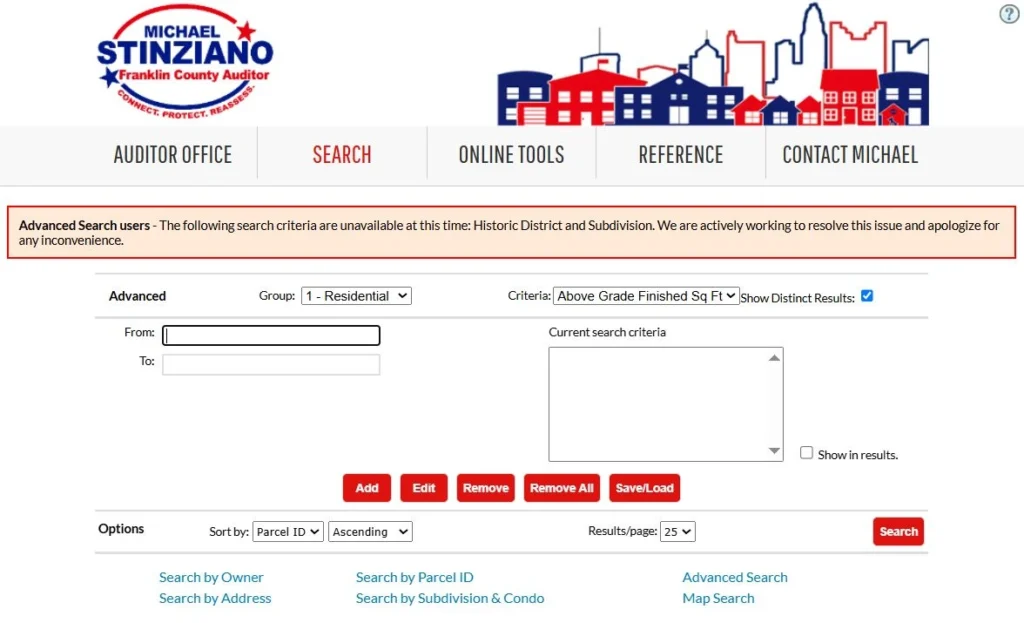
The search mechanics themselves — search syntax, tips for narrowing results, what to do if a property isn’t showing up — are covered in more depth on the property search page. This page picks up from there: once you’ve got a record open, here’s how to make sense of it.
How to Read a Franklin County Property Record
Parcel Number
The parcel number is the unique identifier assigned to a specific piece of property. It stays consistent over time (unless the parcel itself is split or combined with another), which makes it the most reliable way to reference a property across different records, forms, or conversations with county offices.
Owner Information
This section shows who the county currently has on file as the property’s legal owner. Ownership records are updated as transfers are processed, but there can be a lag between when a sale closes and when it’s reflected in the system — so for anything where current ownership matters legally, verify it through the official record rather than relying on a cached or delayed listing.
Property Address
Records typically distinguish between a property’s physical location — sometimes called the situs address — and any mailing address on file for the owner. These aren’t always the same. A landlord who lives elsewhere, an out-of-state land investor, or an estate being managed by a relative are all common reasons the two addresses might differ.
Legal Description
A legal description identifies a parcel’s exact boundaries using formal surveying or platting language — think lot and block numbers within a recorded subdivision, or metes-and-bounds coordinates — rather than a street address. It’s the description that matters for legal and boundary purposes, while the street address is mainly there for everyday identification and mail delivery.
Property Classification
Parcels are generally categorized by how they’re used — residential, commercial, agricultural, industrial, exempt, and so on. Classification can influence how a property is valued and taxed, though the specific categories and their effects are something to confirm through the official system rather than assume from general principles.
Property Characteristics
This covers the physical description of what’s built on the land: square footage, year built, number of rooms, and similar structural details, along with land-specific characteristics like lot size.
Value Information
Property records often show more than one value figure, and it’s worth not treating them as interchangeable. Market value is roughly what a property would sell for. Appraised value is the Auditor’s official estimate of that market value. Assessed value — also called taxable value — is the portion of appraised value that Ohio law actually uses to calculate your tax bill. Seeing several different numbers on one record is normal; each one is doing a different job. For a fuller explanation of how these figures are set and updated, see Franklin County property values.
How to Research Property History
Property records aren’t static — they accumulate history as a parcel is bought, sold, reappraised, and physically changed. To research a property’s history, you’re generally looking at a few different threads:
- Ownership history — previous owners on file for the parcel.
- Sales history — recorded transaction dates and prices, covered in more depth under property sales.
- Transfer history — the formal record of ownership changes, covered under property transfers.
- Valuation history — how appraised and assessed values have changed across past reappraisal and update cycles, covered under property values.
- Characteristic changes — additions, renovations, or permitted work that altered the property over time.
This page can point you toward what each of these threads means; the underlying historical data itself lives in the official county system, which is the place to go for anything you need to confirm or cite.
Property Records vs. Property Search
These two terms get used loosely, but they describe different steps in the same process.
Property search is how you locate a specific parcel — by typing in an address, owner name, or parcel number. Property records are what you’re actually looking at once you’ve found it: the ownership, characteristics, valuation, and history tied to that parcel.
In practice, search comes first and records come second — you search for the property, then read and interpret the record that search turns up. This page focuses on that second step: making sense of what’s in front of you once you’ve found the right parcel.
Are Franklin County Property Records Public?
In general, yes — basic property ownership, characteristic, and valuation information is considered public record in Ohio, which is part of why the county’s search tool is freely accessible without an account. This kind of transparency is fairly standard across U.S. county property systems.
That said, “public” doesn’t necessarily mean every possible detail is displayed online or available without a formal request. Some information may be limited, require a separate request process, or be governed by rules outside the Auditor’s system. If you need a specific document or detail for something legally significant, it’s worth confirming directly with the relevant county office rather than assuming based on general practice.
Why Property Records Matter
People end up researching property records for a lot of different reasons:
- Buying a home — checking characteristics and valuation before making an offer.
- Selling a property — confirming your own record is accurate before listing.
- Verifying ownership — for a transaction, a dispute, or general due diligence.
- Understanding a property’s characteristics — square footage, lot size, year built.
- Researching history — past sales, transfers, or changes to a parcel.
- Reviewing valuation — especially ahead of a reappraisal cycle or a potential Board of Revision case.
- Preparing for a tax question — records are the starting point before a conversation about a tax bill.
- Checking neighboring properties — useful context when evaluating your own.
Frequently Asked Questions
How do I find Franklin County property records?
Start with a Franklin County property search by address, owner name, or parcel number. The matching record will show the property’s available information.
How do I look up a property owner in Franklin County?
Search by address or parcel number if you have either — the resulting record will show the current owner on file. You can also search directly by owner name.
What is a Franklin County parcel number?
It’s the unique ID the county assigns to a specific piece of property. It’s the most reliable way to reference a parcel and is usually the fastest way to pull up its record directly.
Can I search property records by address?
Yes. Address is one of the standard ways to search; owner name and parcel number are the other two.
What information is included in a property record?
Typically address, parcel number, ownership, legal description, classification, land and building characteristics, valuation figures, tax district, and sales or transfer history where available — though not every field appears on every record.
How can I research a property’s history?
Look at the record’s ownership, sales, transfer, and valuation history sections. Each reflects a different kind of change the parcel has gone through over time.
Are Franklin County property records public?
Generally, yes — basic ownership and valuation information is public and freely searchable. Some specific documents or details may require a separate request or be governed by other rules.
Are property records the same as deeds?
No. A property record is the Auditor’s descriptive and valuation profile of a parcel. A deed is the actual legal document recording a transfer of ownership, maintained by the Recorder’s Office.
Where can I verify current Franklin County property information?
Through the official Auditor property system, linked below. This page explains how to interpret records but doesn’t host live data itself.
How often is property information updated?
It varies by field — ownership and sales data update as transactions are processed, while valuation figures update on the county’s reappraisal and triennial update cycle. For anything time-sensitive, verify directly with the official system.
Verifying Official Information
Franklin County Property Guide explains how property records work, but it isn’t the Franklin County Auditor’s Office and doesn’t maintain the official record system.
Need to look up a specific property? Start with the Franklin County property search. For the live, official version of that same tool, visit property.franklincountyauditor.com, maintained by the Franklin County Auditor’s Office.